


재난이나 비상사태 발생 후 식품 안전 보관 방법

If you are in a disaster or emergency, take steps to prevent illness from unsafe food. Refrigerated or frozen foods may not be safe to eat after a loss of power. Food that may have had contact with floodwater or storm water may also be unsafe to eat.

Prepare for emergencies

  • Keep appliance thermometers in your refrigerator and freezer. The refrigerator should be at 40°F or below. The freezer should be at 0°F or below.
  • Freeze containers of water and gel packs to help keep food at 40°F or below.
  • Have a cooler and frozen gel packs ready in case you have to remove food from the refrigerator to keep it cold.
  • Buy dry ice or block ice to keep food cold in the refrigerator if you think the power could be out for a long time.

Steps to take during a power outage

  • Keep refrigerator and freezer doors closed.
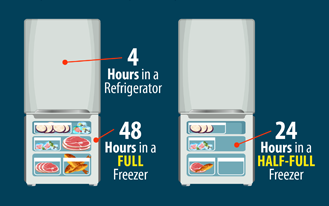
  • If the doors stay closed, food will stay safe up to: 4 hours in a refrigerator, 48 hours in a full freezer, 24 hours in a half-full freezer.
  • If the power has been out for 4 hours, and a cooler and ice are available, put refrigerated perishable foods in the cooler. To keep them at 40°F or below, add ice or a cold source like frozen gel packs.
Image of refrigerator and freezer with text by refrigerator saying "4 hours" and text by freezer saying "48 hours in a full freezer and 24 hours in a half-full freezer."
Food will last in a fridge for 4 hours without power. Frozen food will last 48 hours in a full freezer and 24 hours in a half-full freezer.

Steps to take after a power outage

  • Never taste food to know if it is safe to eat. When in doubt, throw it out.
  • Throw out perishable food in your refrigerator (meat, fish, cut fruits and vegetables, eggs, milk, and leftovers) after 4 hours without power or without a cold source like ice. Throw out any food with an unusual smell, color, or texture.
  • If you have an appliance thermometer in your refrigerator, check to see if it is still at 40 °F or below.
  • Check temperatures of food kept in coolers or your refrigerator with an added cold source. Throw out food that has thawed or is above 40°.
  • You can safely refreeze or cook thawed frozen food that still contains ice crystals or is at 40 °F or below.

Resource

Check this FoodSafety.gov chart for a list of what foods you should throw out and foods you can refreeze.

원천: 질병통제예방센터

이 기사를 공유하세요